Japanese vs Korean skincare: what actually differs
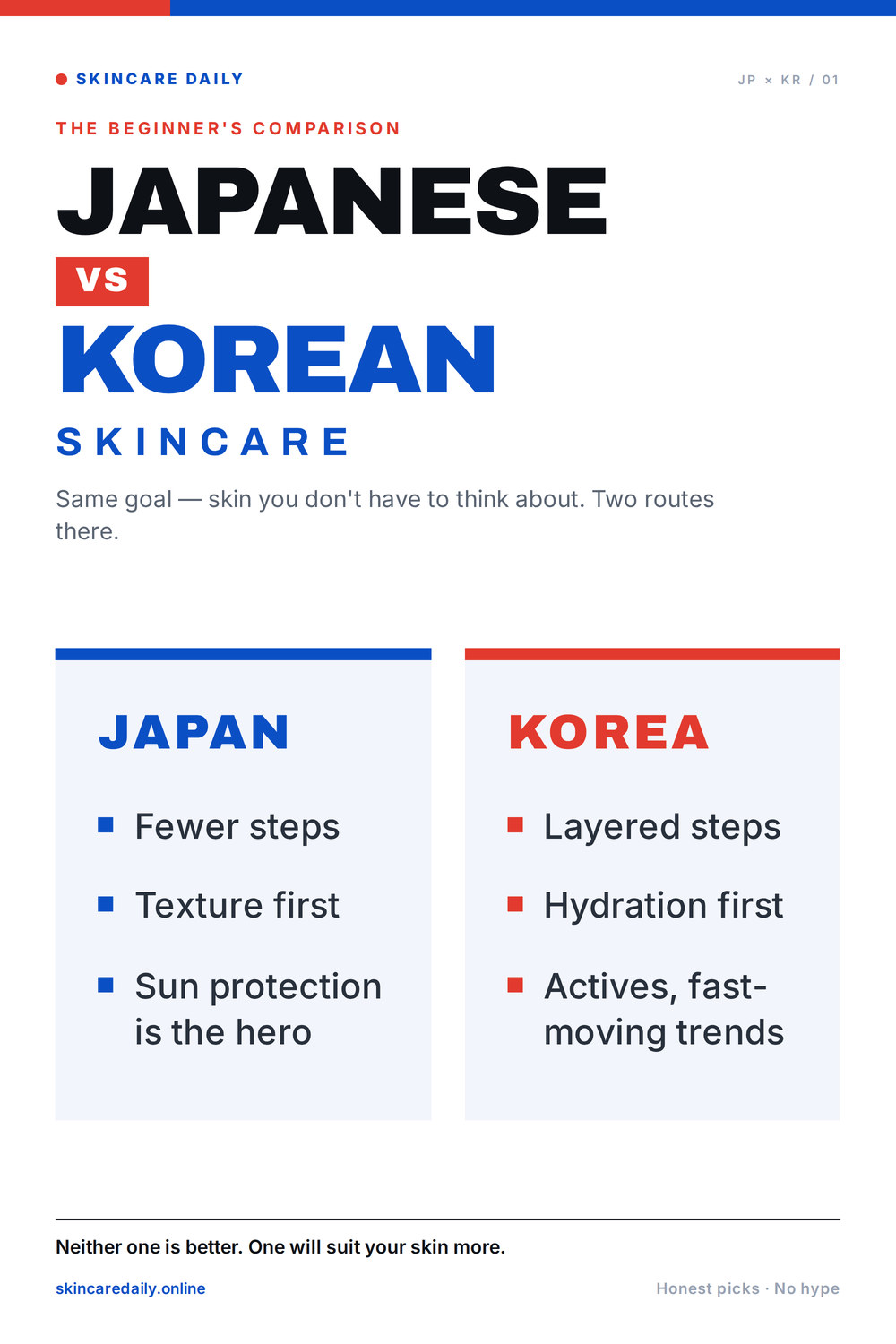
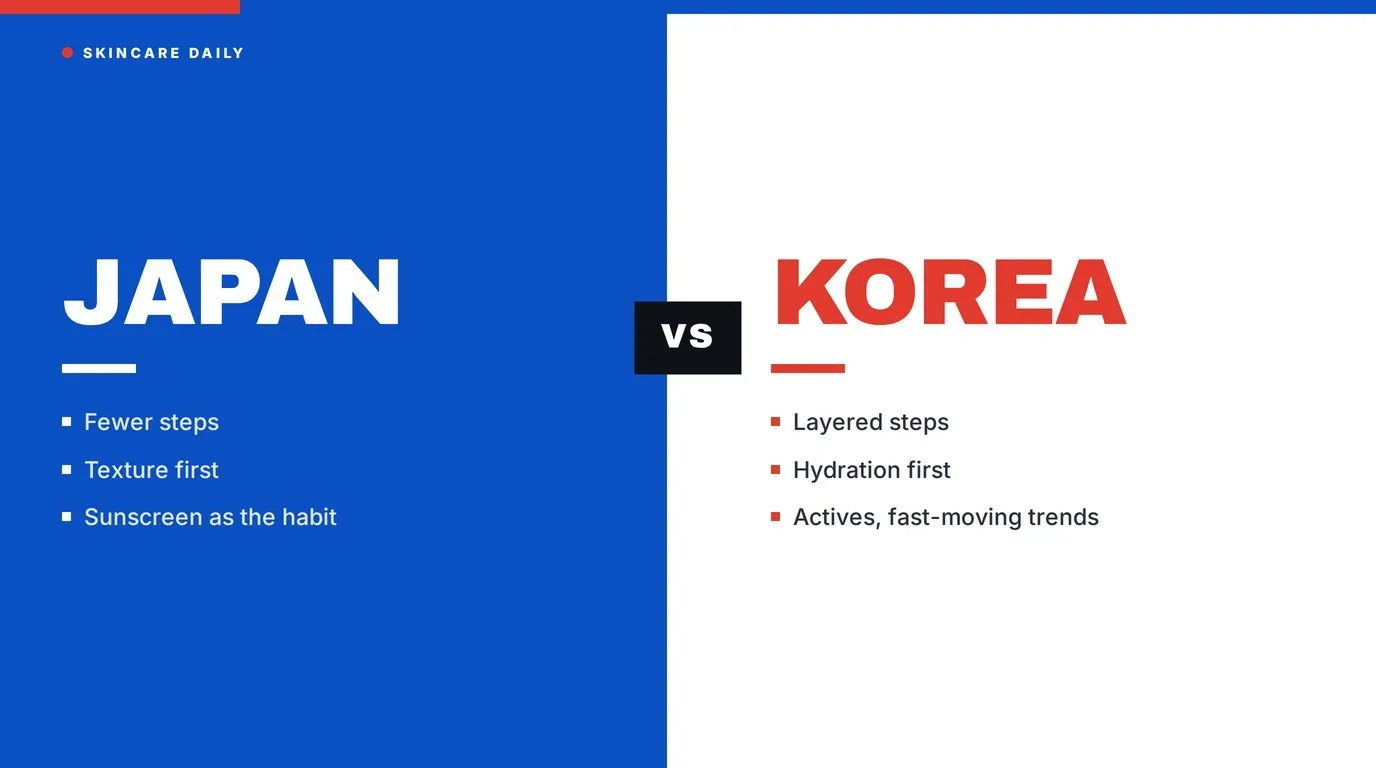
Japan and Korea chase the same thing by different routes: fewer steps and lighter textures against layered hydration. Here is what really separates them.

Every few weeks someone asks me a version of the same question: Japanese or Korean? They have read that one is minimal and one is ten steps, that one is about hydration and the other about barriers, and they want to know which side to pick before they spend any money.
The honest answer is that the question is slightly wrong. These are not two philosophies at war. They are two large, ordinary consumer markets that grew up next to each other, sell many of the same ingredients, and differ mostly in emphasis — in what gets put in the window rather than what is on the shelf.
But the emphasis is real, and it is worth understanding before you buy, because it is the thing that will decide whether a product feels right on your face.
The difference is climate, regulation and retail
Three unglamorous forces explain nearly all of it.
Climate. Tokyo in August is around 30°C at ninety percent humidity, and that has shaped what sells here for decades. Japanese textures skew watery, fast-absorbing and matte because anything richer is unwearable for a third of the year. Seoul gets a properly cold, dry winter, and Korean textures skew softer and more cushioned for the same reason in reverse.
Regulation. Japan has a middle category between cosmetic and drug called 医薬部外品 — quasi-drug — where a specific list of approved actives can be sold with a specific approved wording. Korea has its own version, “functional cosmetics”, administered by its Ministry of Food and Drug Safety. Both systems let a bottle say things a US cosmetic label cannot, and both push formulators toward whatever their regulator has already cleared.
Retail. Japanese brands iterate slowly and keep products on shelves for years. Korean brands launch fast, and a hit product can appear, saturate the internet and be reformulated inside eighteen months. Neither is better. One gives you stability, the other gives you novelty, and you probably already know which of those you enjoy.
Two markets, the same chemistry, different weather and different paperwork.
Routine length, and the ten-step thing
Let me deal with this first, because it is the single most repeated idea about Korean skincare and it is mostly an artefact of export marketing.
“Ten steps” arrived in the West around the middle of the 2010s as a way to explain an unfamiliar category to magazine readers, and it stuck because it was a good headline. It was never a rule anyone was following. The people I know in Seoul run four or five steps on a normal day, same as here, and add a mask or an extra layer when their skin is unhappy or the weather turns.
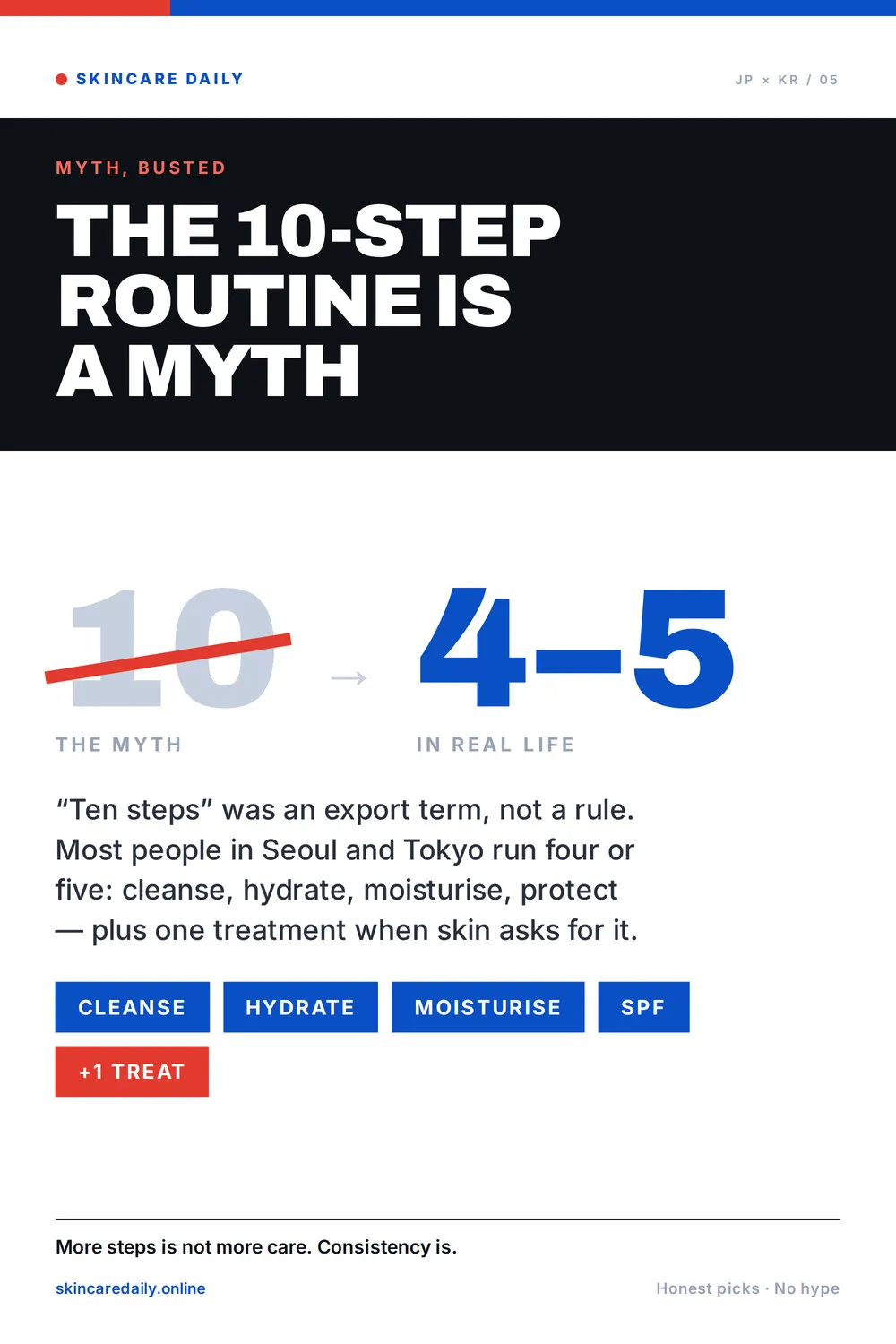
Where the two markets genuinely differ is what happens in the middle. A Japanese routine tends to put one watery layer and one light emulsion between cleansing and sunscreen. A Korean routine is more comfortable stacking two or three thin layers in that gap — toner, essence, then a serum — on the logic that several thin layers sit better than one thick one.
That is a real difference of approach. It is not eight extra products.
The words on the bottle are not the words you know
This trips up more beginners than anything else, and it costs people money, because a product used in the wrong slot does nothing and gets blamed for it.
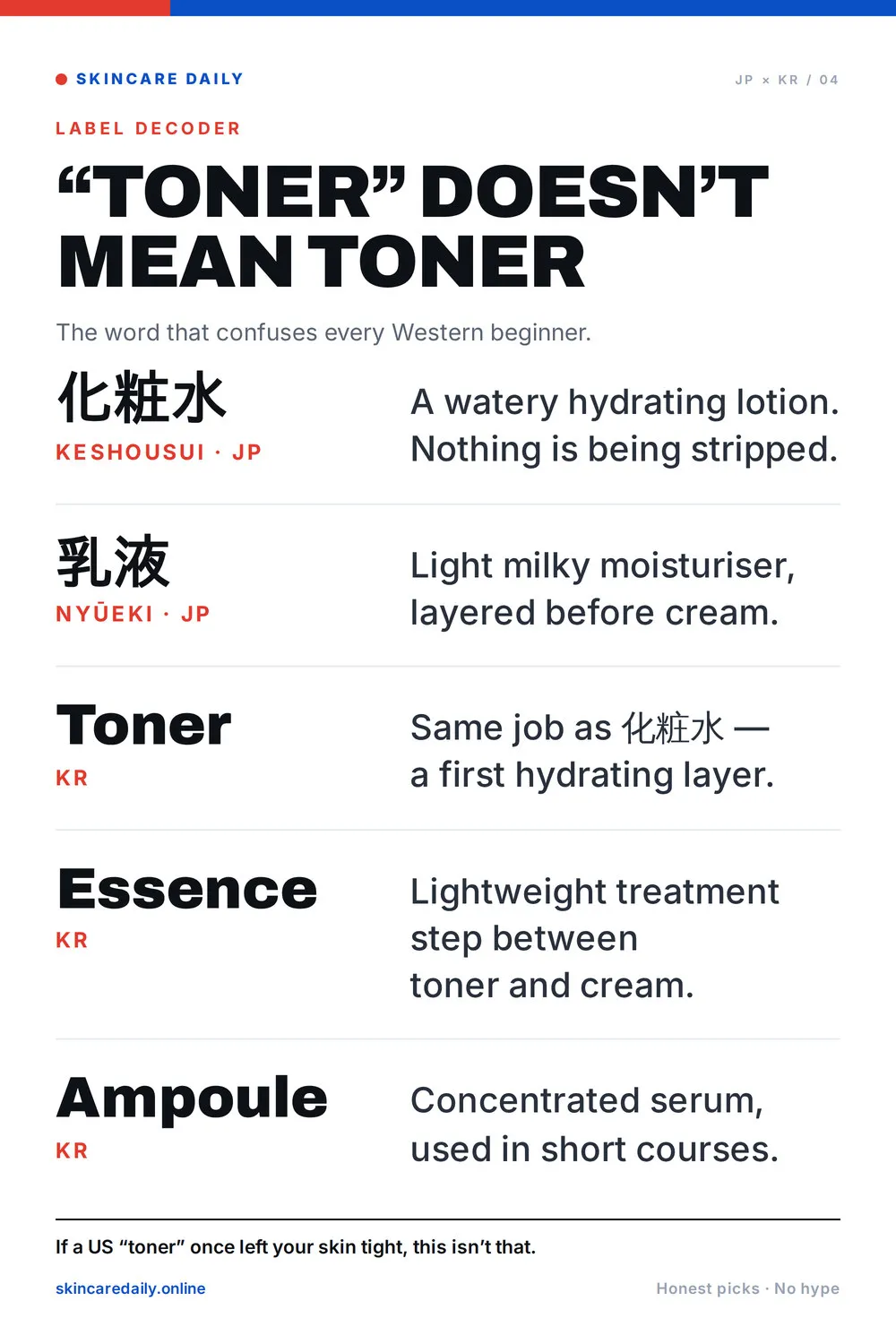
The word to watch is “toner”. In the US it has historically meant an astringent, alcohol-forward wipe-down after cleansing. In both Japan and Korea it means the opposite: the first hydrating layer of the routine, a water you press in while your face is still slightly damp. Japan calls it 化粧水 — keshousui — and translates it on the box as “lotion”, which sends English speakers down a second wrong path.
I wrote a whole post about that one word, because it is the mistake I see most: the Japanese lotion that is not lotion.
This is the bottle most people here start with, and it is the cheapest possible way to find out whether you like the watery-layer approach at all. It is unscented, it is slightly slippery going on, and it does not smell or feel like a luxury product, because it is not one — it is a supermarket staple that happens to be good.
Cleansing: one is borrowed from the other
Double cleansing gets filed under Korean skincare almost everywhere online. It is Japanese in origin — an oil-first habit built around removing heavy makeup, long predating the routine boom — and Korea is what made the rest of the world do it.
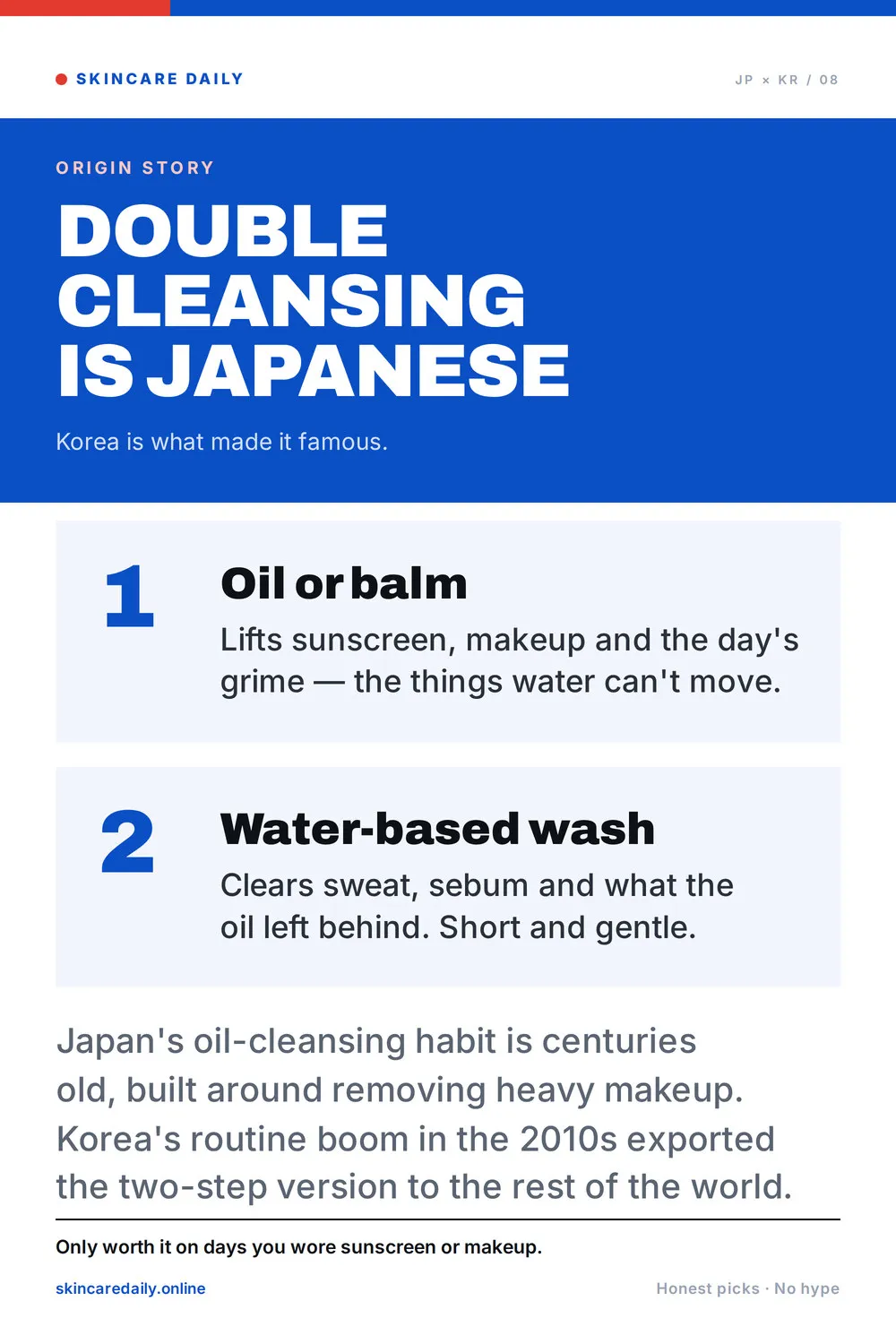
Both shelves now sell the same two-step idea, and the split is textural rather than conceptual: Japan leans toward thin cleansing oils, Korea toward balms and low-pH gels. If you are not wearing sunscreen or makeup that day, neither market thinks you need two cleanses at night. The full version is here: double cleansing, from where it started.
The one-page Japanese drugstore shopping list
Every product on this site that is worth your money, on a single page you can screenshot before you shop. Plus a note when a new post goes up.
Setup needed. Add your
Kit form ID to KIT_FORM_ID in src/consts.ts and this becomes a working signup form.
Instructions are in the README under "Turning on the email list".
Sunscreen is where both of them are ahead
If you take one thing from this page, take this one.
Sunscreen in the US is regulated as an over-the-counter drug, which means new UV filters go through a drug approval pathway and the available list has barely moved in decades. Japan and Korea both regulate it as a cosmetic, both approve a longer and more recently updated list of filters, and both print a PA rating — the label’s UVA scale, which US bottles do not carry at all.
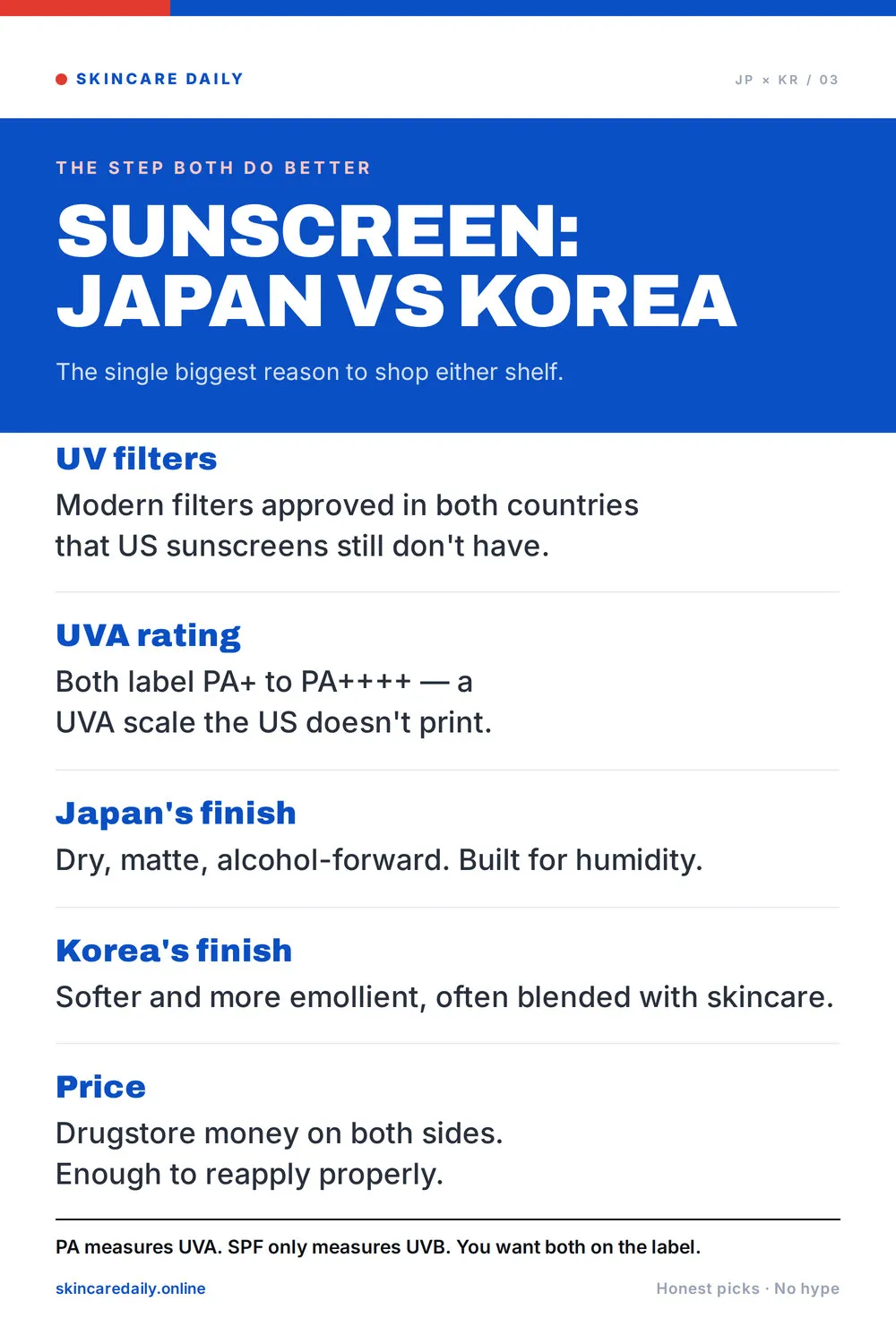
What that does is textural, and it is the reason people import. When your formulator has lighter materials to build with, they can make something that spreads like a serum rather than like a paste. Japanese sunscreens tend to run dry, matte and alcohol-forward, built for a humid commute. Korean ones tend to run softer and more emollient, often blended with skincare ingredients, and they suit dry skin and cold air better.
I have compared these against the American shelf in more detail here: Japanese sunscreen vs American sunscreen.
Ingredients: same chemistry, different house style
Read the back of enough bottles from both countries and the overlap becomes obvious. Glycerin, hyaluronic acid, niacinamide and ceramides are everywhere on both shelves. What differs is the hero ingredient — the thing the front of the box is built around.
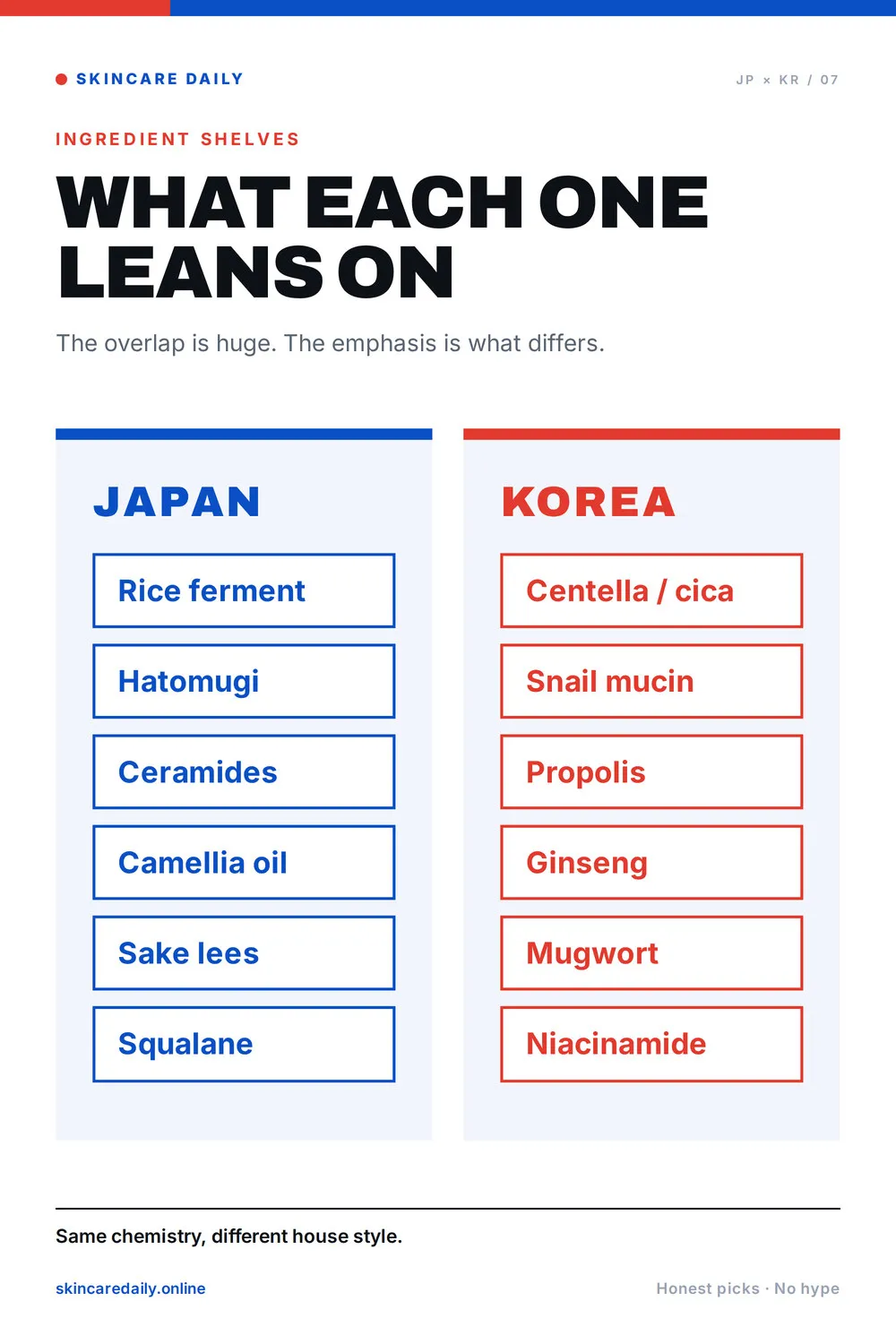
Japan builds around ferments and traditional agricultural ingredients: rice ferment, sake lees, ハトムギ (hatomugi, Job’s tears), camellia oil. Korea builds around botanicals with a story: centella, mugwort, ginseng, propolis, and the snail mucin that everyone has an opinion about.
Which of those actually does anything for you is not a question I can answer, and I would be suspicious of a blog that claims it can. What I can tell you is that they feel different — ferment-led Japanese lotions tend to be thin and slightly slippery, Korean centella products tend to be cushiony.
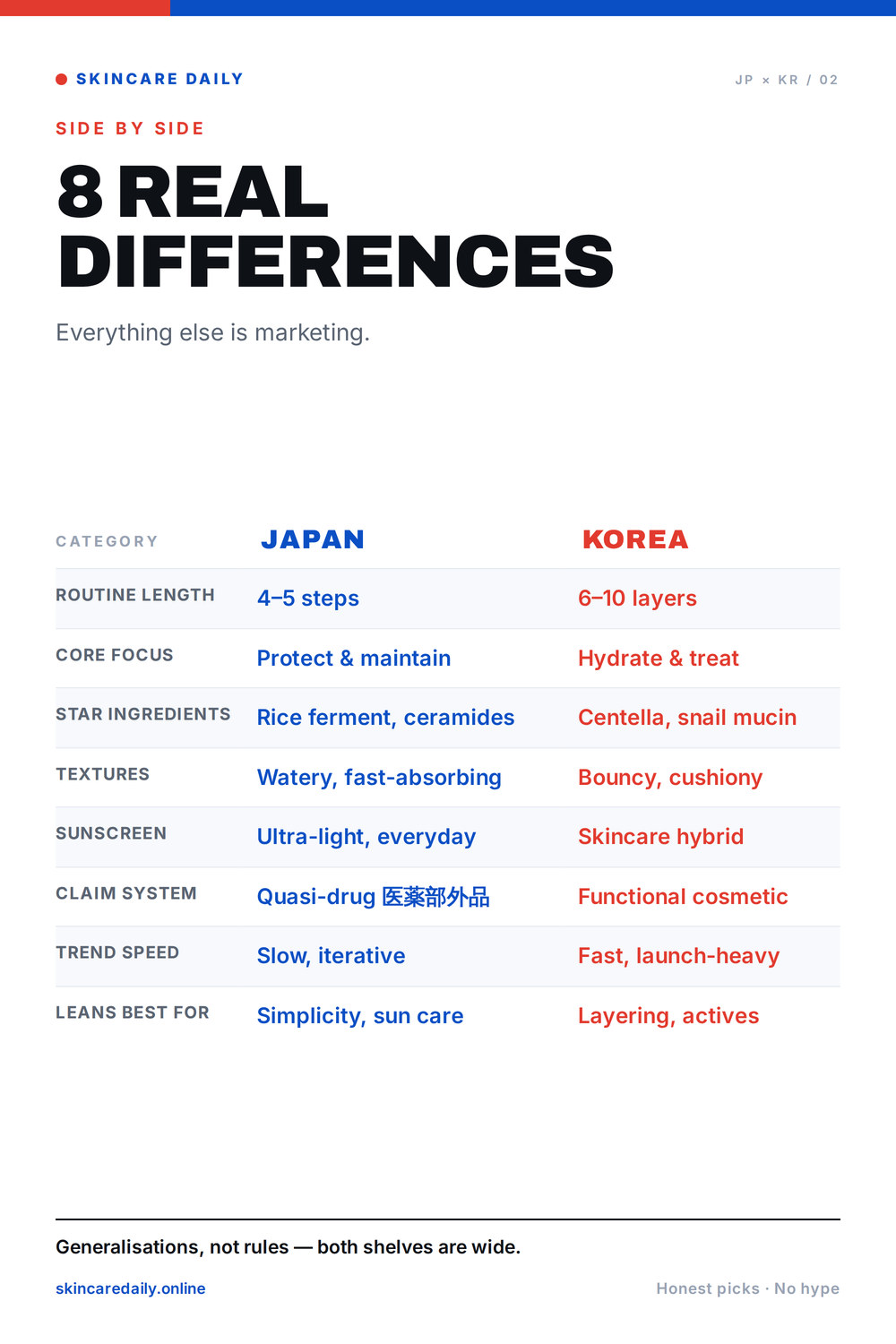
Eight differences, side by side
| Japan | Korea | |
|---|---|---|
| Routine length | 4–5 steps | 6–10 layers |
| Core emphasis | Maintain and keep steady | Hydrate and layer |
| Star ingredients | Rice ferment, ceramides | Centella, snail mucin |
| Textures | Watery, fast-absorbing | Bouncy, cushiony |
| Sunscreen style | Ultra-light, everyday | Skincare hybrid |
| Claim system | Quasi-drug 医薬部外品 | Functional cosmetic |
| Trend speed | Slow, iterative | Fast, launch-heavy |
| Leans best for | Simplicity, sun care | Layering, actives |
These are generalisations and both shelves are wide enough to break every one of them. They are still the right starting expectations.
What a full routine costs
Neither of these is a luxury category at home. Both are drugstore categories that get marked up on the way across an ocean, and the ranges below are what I see on iHerb and Amazon in the US rather than what I pay in Tokyo.
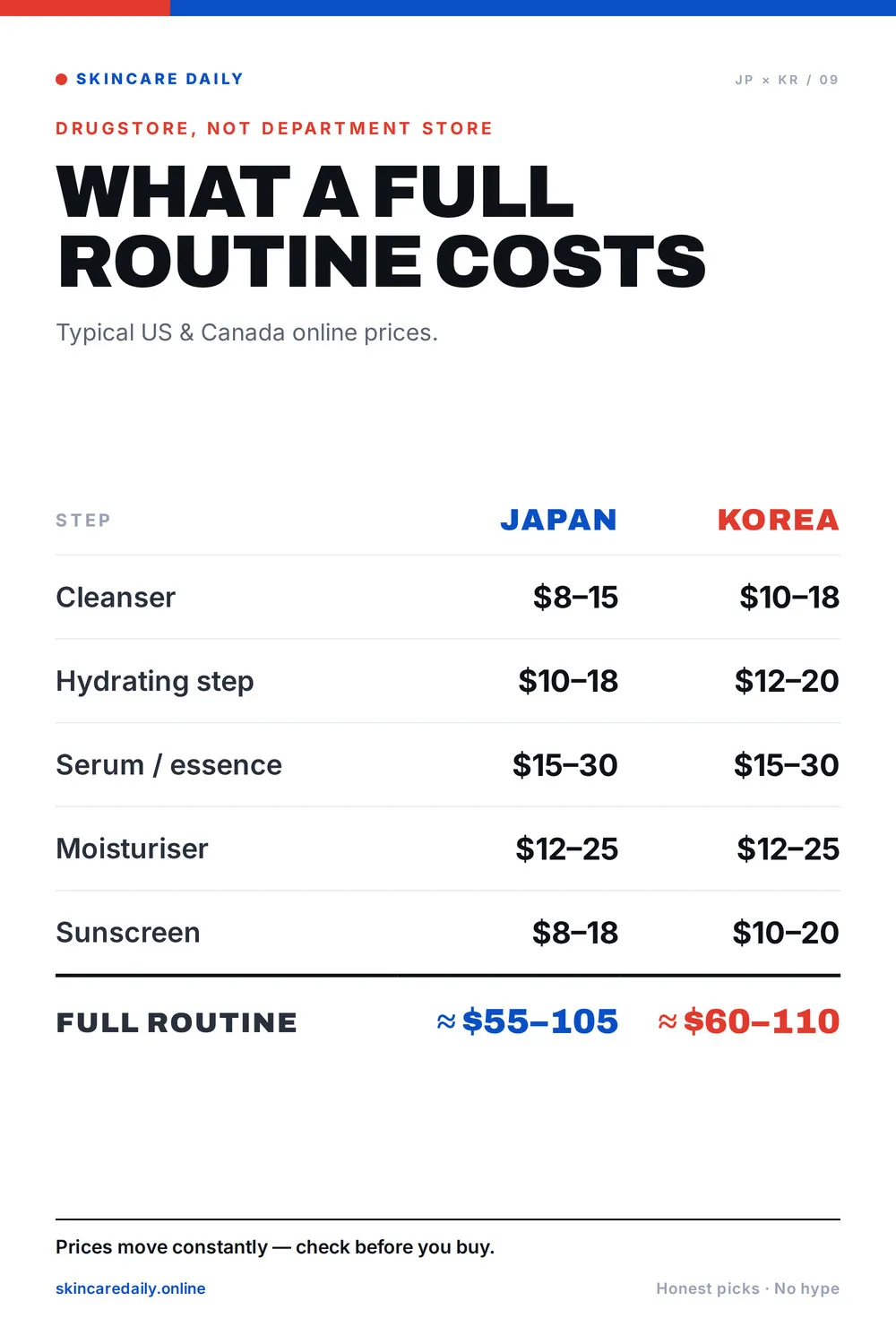
Two notes. Prices move constantly, so treat these as a shape rather than a quote. And a full routine is not the sensible way to start — one product at a time, four weeks each, is how you find out what your skin actually likes without wasting sixty dollars discovering you hate a texture.
What I am not going to tell you
I want to be direct, because a lot of pages in this corner of the internet are not.
I buy this stuff and use it. I can tell you how something feels, how it smells, whether it pills under makeup, whether it survives a humid commute, and whether I bought the bottle a second time. That is what I actually know.
I am not going to tell you which country’s products work better, rank them by what they do to skin at a biological level, or tell you what to use for acne, eczema or pigmentation. I am not qualified to, and the honest answer to those questions is a dermatologist rather than a blog. If your skin is painful, changing, or not responding to ordinary care, that is the conversation to have.
So which one should you buy?
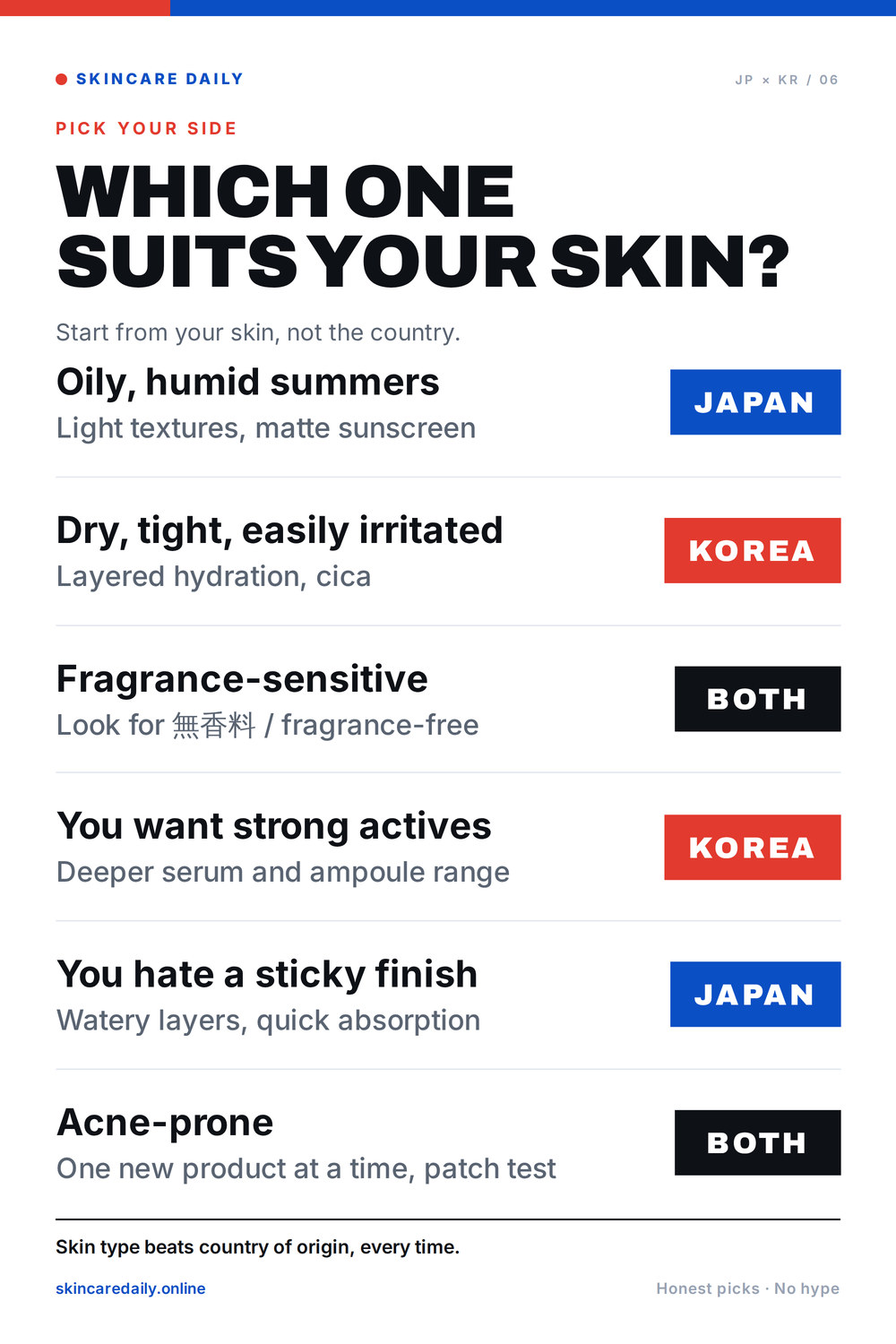
Start from your skin rather than from a country.
If you live somewhere hot and humid, run oily, or cannot stand a tacky finish, the Japanese shelf will suit you sooner. If you are dry, tight and easily irritated, or you like the idea of building a routine out of layers you can adjust, the Korean shelf gives you more to work with. If you are sensitive to fragrance, both markets sell plenty of 無香料 (unscented) options — you just have to look for the word.
The routine most people actually land on
Here is the thing nobody selling you a philosophy will say: after a year or two of trying both, almost everyone ends up somewhere in the middle.
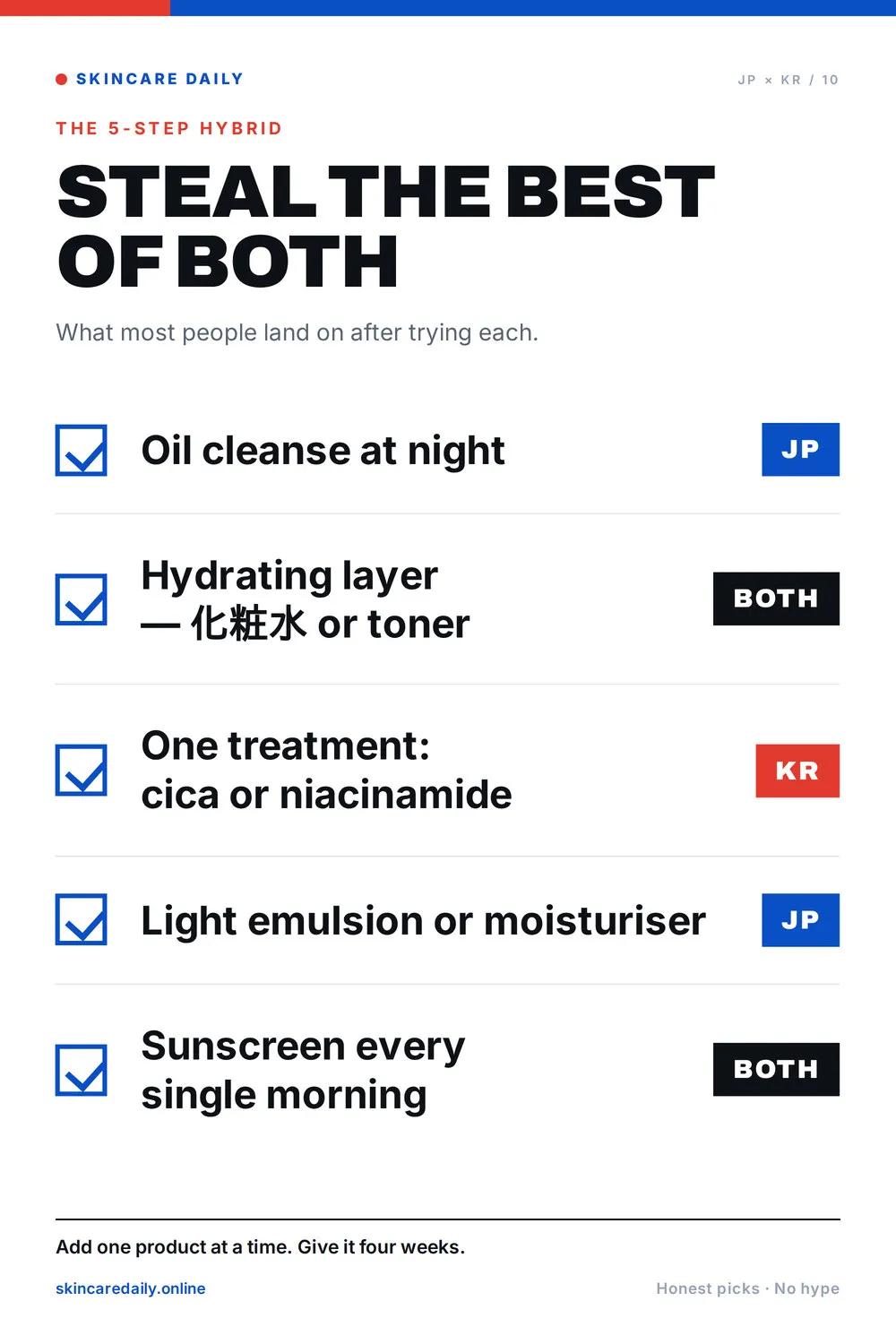
Japanese oil cleanser because the textures are good and the prices are low. A hydrating layer from whichever bottle you liked. One Korean treatment step, because that shelf has more of them. A light emulsion or cream. Sunscreen every morning, from either country, because that is the step that makes the rest of it worth doing.
That is five steps, it costs less than most single Western serums, and it does not require you to pick a side.
Everything mentioned
2 items
Prices are what I last paid or last saw on the shelf. They move.
Before you go: the one-page japanese drugstore shopping list
Every product on this site that is worth your money, on a single page you can screenshot before you shop. Plus a note when a new post goes up.
Setup needed. Add your
Kit form ID to KIT_FORM_ID in src/consts.ts and this becomes a working signup form.
Instructions are in the README under "Turning on the email list".